
Diamond Length-to-Width Ratio: Understanding Diamond Proportions
The length-to-width ratio is one of the most useful measurements for understanding the visible shape and proportions of a diamond. Two diamonds can have the same carat weight, colour and clarity while looking very different when viewed from above.
One stone may appear compact and square, while another may appear longer and more slender. The length-to-width ratio helps describe this difference and is particularly useful when evaluating fancy-shaped diamonds.
What Is the Diamond Length-to-Width Ratio?
The length-to-width ratio, commonly written as the L/W ratio, describes the outline of a diamond when viewed from above, also known as the face-up view.
A ratio close to 1.00 indicates that the length and width are nearly equal, producing a more square or symmetrical appearance. As the ratio increases above 1.00, the diamond becomes progressively more elongated.
For example:
- 1.00 — approximately square or round
- 1.30 — moderately elongated
- 1.50 — noticeably elongated
- 2.00 — strongly elongated
The ratio is particularly useful for fancy shapes such as oval, emerald, pear, marquise, radiant and cushion diamonds.
How to Calculate Diamond Ratio
Calculating the length-to-width ratio is simple.
Length ÷ Width = Length-to-Width Ratio
Both measurements are normally provided in millimetres on a diamond grading report.
Example
Suppose a diamond measures:
10.00 mm × 7.00 mm
The calculation is:
10.00 ÷ 7.00 = 1.43
Therefore, the diamond has a length-to-width ratio of approximately:
1.43 : 1
Another example:
9.10 mm ÷ 7.00 mm = 1.30
This represents a more moderately elongated outline.
Why Does Diamond Ratio Matter?
The length-to-width ratio can influence several aspects of a diamond’s appearance.
1. It Influences the Diamond’s Shape
A higher ratio generally creates a longer and narrower outline, while a ratio closer to 1.00 creates a squarer or fuller appearance.
This is particularly noticeable with fancy-shaped diamonds.
For example, two oval diamonds may have similar carat weights but different ratios. One may look fuller and rounder, while the other may appear longer and more slender.
2. It Affects Perceived Size
Elongated diamond shapes can create greater visual coverage across the finger because more of the diamond’s weight is distributed across its length.
This means that two diamonds with the same carat weight can have different face-up appearances.
3. It Can Influence Light Performance
Ratio should not be considered separately from cut quality and proportions.
Extremely elongated proportions can sometimes be associated with visual issues such as a pronounced bow-tie effect in certain shapes, including oval, pear and marquise diamonds. The actual diamond should therefore be evaluated rather than relying on the ratio alone.
4. It Can Influence Value
The market can respond differently to various proportions. Diamonds with attractive proportions and desirable outlines may command stronger prices, while unusual proportions may appeal to a smaller group of buyers.
However, there is no single ratio that is universally best. Personal preference and the individual diamond’s overall appearance remain important.
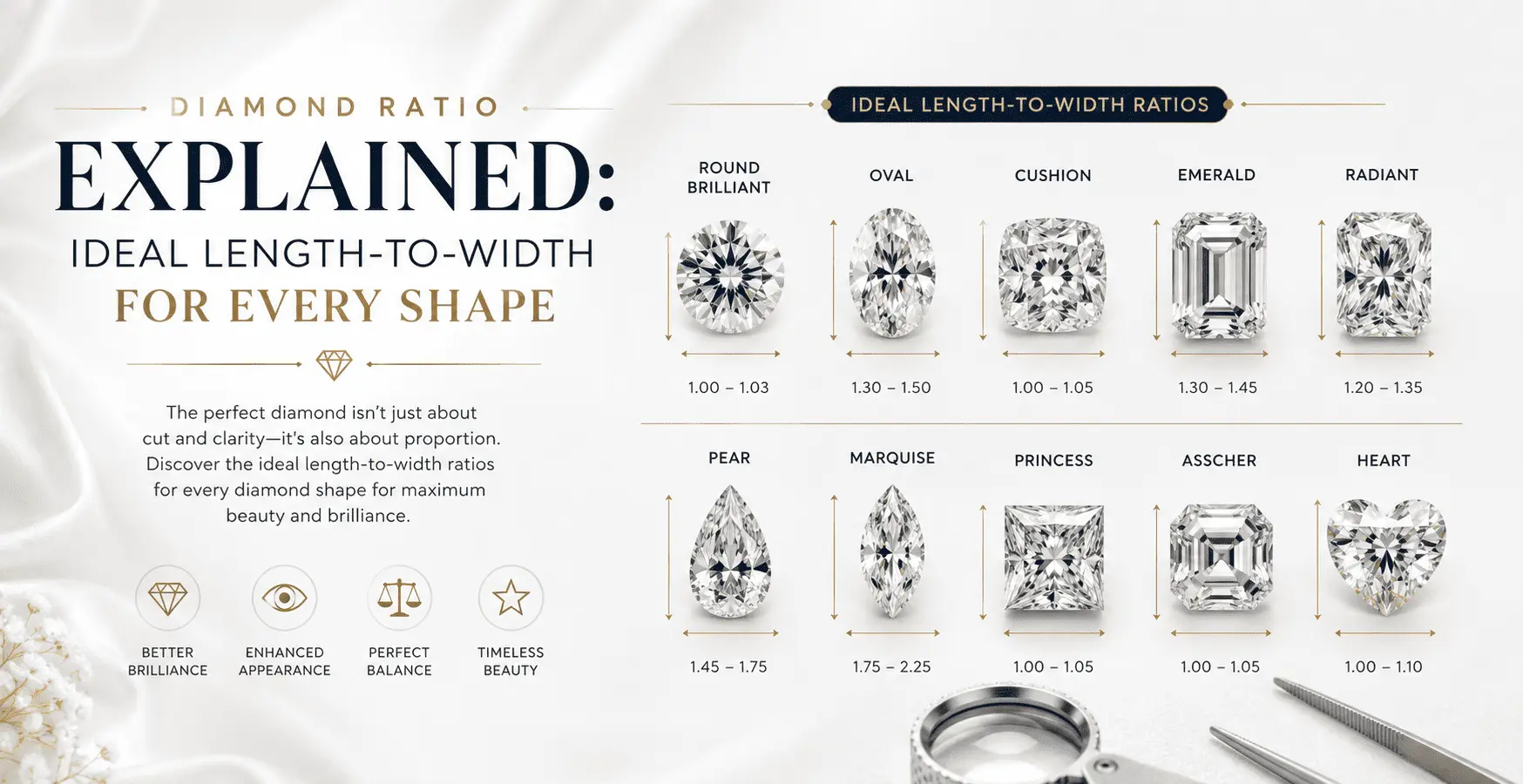
Common Length-to-Width Ratios by Diamond Shape
Different diamond shapes naturally work with different ratio ranges.
| Diamond Shape | Common Reference Range |
|---|---|
| Round | 1.00 – 1.03 |
| Princess | 1.00 – 1.05 |
| Cushion | 1.00 – 1.30 |
| Asscher | 1.00 – 1.05 |
| Emerald | 1.30 – 1.60 |
| Oval | 1.30 – 1.50 |
| Radiant | 1.00 – 1.50 |
| Pear | 1.40 – 1.75 |
| Marquise | 1.75 – 2.25 |
| Heart | 0.95 – 1.05 |
These should be treated as reference ranges rather than strict rules. The preferred appearance depends on the individual stone, its proportions, symmetry, faceting and the buyer’s personal preference.
Diamond Ratio by Shape
Round Diamond
Round diamonds are designed to appear circular, so their measurements should be very close to one another.
A ratio close to 1.00 is generally expected for a properly proportioned round diamond. A noticeable difference between the measurements can indicate that the stone is not perfectly round.
Oval Diamond
Oval diamonds are available in a wide variety of proportions.
A ratio around 1.30 to 1.50 is commonly encountered, ranging from fuller ovals to more elongated outlines.
When selecting an oval diamond, ratio should be considered together with symmetry, facet pattern and bow-tie appearance.
Emerald Diamond
Emerald-cut diamonds generally have a rectangular outline created by their step-cut faceting.
A ratio around 1.30 to 1.60 can create different visual appearances, from relatively balanced rectangles to longer, more elongated designs.
Pear Diamond
Pear-shaped diamonds combine a rounded end with a pointed tip.
Ratios around 1.40 to 1.75 are commonly referenced. A lower ratio can produce a fuller pear, while a higher ratio creates a longer and narrower appearance.
Symmetry is especially important when evaluating pear diamonds.
Marquise Diamond
Marquise diamonds are naturally elongated and are known for their distinctive pointed ends.
A commonly referenced range is approximately 1.75 to 2.25.
Higher ratios produce a longer, more dramatic appearance, while lower ratios create a fuller outline. Symmetry between the two halves of the stone is particularly important.
Radiant Diamond
Radiant diamonds can range from nearly square to noticeably rectangular.
Square-style radiants may have ratios close to 1.00, while elongated rectangular radiants can reach approximately 1.30–1.50.
Cushion Diamond
Cushion diamonds can have either a square or elongated appearance.
Square cushions commonly fall around 1.00–1.10, while elongated cushions can extend into approximately the 1.15–1.30 range.
Princess Diamond
Princess diamonds are traditionally recognized for their square appearance.
A ratio close to 1.00–1.05 generally maintains that crisp square outline. Higher ratios can make the diamond appear increasingly rectangular.
Asscher Diamond
Asscher diamonds are traditionally square step-cut stones.
A ratio close to 1.00–1.05 helps maintain their characteristic square outline and symmetrical appearance.
Heart Diamond
Heart-shaped diamonds have a distinctive symmetrical outline.
A ratio close to 1.00 generally creates a balanced appearance, while ratios around 0.95–1.05 can create slightly wider or more elongated heart shapes.
How to Choose the Right Diamond Ratio
There is no universal ratio that is perfect for every diamond.
Instead, consider the following process:
1. Choose the Diamond Shape
Start by deciding which shape you prefer.
The same ratio can produce very different appearances in an oval, pear, emerald or marquise diamond.
2. Decide Your Preferred Appearance
Would you prefer a:
- Fuller and wider outline?
- Balanced outline?
- Long and slender appearance?
Generally, a lower ratio creates a fuller outline, while a higher ratio produces greater elongation.
3. Compare Actual Measurements
Don’t compare diamonds only by carat weight.
Look at the actual millimetre measurements because diamonds with the same carat weight can have different dimensions and face-up appearances.
4. Check Symmetry
Ratio alone cannot describe the entire outline.
Look for balanced shoulders, wings, lobes, points and overall symmetry where applicable.
5. Evaluate Light Performance
A desirable ratio does not automatically mean the diamond has excellent light performance.
Consider the actual diamond’s brightness, scintillation, fire and any visible bow-tie effect.
6. Consider the Jewellery Setting
The final setting can change how the diamond’s proportions appear.
Solitaire, halo and three-stone settings can each influence the visual perception of the stone.
7. Consider Your Personal Preference
Reference ranges are useful starting points, but they are not rules.
The best ratio is ultimately the one that produces an appearance you genuinely prefer.
Diamond Ratio, Price and Perceived Size
Diamond ratio can also be considered when comparing value and visual coverage.
An elongated diamond can provide greater face-up coverage relative to its carat weight, while a more compact diamond may have a smaller visible footprint.
When comparing two diamonds, consider:
Carat Weight + Millimetre Measurements + Ratio + Cut/Proportions + Overall Appearance
This gives a more complete picture than considering carat weight alone.
Common Mistakes When Choosing a Diamond Ratio
1. Choosing Based Only on Carat Weight
Two diamonds with the same carat weight can look very different because of their proportions.
Always review the length and width measurements.
2. Choosing an Extreme Ratio Without Evaluating the Stone
Very elongated proportions may create visual issues depending on the shape.
Always evaluate the actual diamond.
3. Ignoring the Jewellery Setting
The setting can affect how the diamond’s proportions are perceived.
4. Relying Only on Photographs
Online photographs can sometimes distort how a diamond appears.
Whenever possible, review the diamond’s measurements and grading documentation.
5. Forgetting Personal Preference
An “ideal” range is only a reference.
Your preferred shape and appearance should ultimately guide your selection.
Frequently Asked Questions
What is the best length-to-width ratio for a diamond?
There is no single best ratio for every diamond shape. Different shapes have different commonly preferred ranges, and personal preference plays an important role.
Is the ratio printed on a diamond grading report?
The length and width measurements are normally provided on grading reports. If the ratio itself is not listed, it can be calculated by dividing the length by the width.
Does a higher ratio make a diamond look bigger?
An elongated diamond can create a larger face-up appearance because its carat weight is distributed across a greater length. However, ratio should always be considered together with the stone’s actual measurements and proportions.
Do the same ratio guidelines apply to natural and lab-grown diamonds?
The geometric principle of length-to-width ratio applies to both natural and lab-grown diamonds. The ratio describes the shape and outline of the stone regardless of its origin.
Final Thoughts
The length-to-width ratio is a simple measurement, but it can provide valuable insight into the appearance of a diamond.
By understanding the ratio, comparing actual millimetre measurements, evaluating symmetry and proportions, and considering the intended jewellery setting, you can make a more informed comparison between diamonds.
Most importantly, treat ratio ranges as guidelines rather than rigid rules. The individual diamond, its overall appearance and your personal preference should always be part of the final decision.